📝 Roofing Guide
Flat Roof Guide for Brooklyn Homeowners: Materials, Lifespan, and What It Costs in 2026
By MLM Construction Group · Brooklyn, NY
One of the most common questions Brooklyn homeowners ask is: "How much longer does my roof have?" The answer depends heavily on the material, installation quality, and maintenance. Here's what you need to know.
Brooklyn experiences harsh winters, hot humid summers, and heavy rainfall, a challenging combination. Freeze-thaw cycles are the #1 killer of roofs in our area: water seeps into small cracks, freezes and expands, then cracks the material further. This repeats dozens of times each winter, accelerating wear. Choose materials rated for this climate and ensure proper flashing and drainage.
Lighter colors reflect more heat and can extend shingle life slightly. Dark roofs absorb more heat, which can accelerate shingle aging in hot Brooklyn summers.
Technically yes, but it's not recommended for Brooklyn homes. Adding weight and trapping moisture leads to faster deterioration. A full tear-off gives you a clean inspection of the decking and a proper fresh start.
Every 2 years for roofs under 15 years old, annually for older roofs. After major storms, always get an inspection regardless of age.
| Material | Expected life in Brooklyn | What usually ends it early |
|---|---|---|
| 3 tab asphalt shingle | 15 to 20 years | Wind uplift on unsealed courses, poor attic ventilation |
| Architectural shingle | 22 to 30 years | Attic heat, failed flashing at penetrations |
| Modified bitumen | 15 to 20 years | Ponding water and open seams |
| EPDM rubber | 20 to 30 years | Shrinkage pulling at the edges, punctures |
| TPO | 20 to 25 years | Seam failure where welds were not run properly |
| Standing seam metal | 40 to 70 years | Fastener and panel movement, rarely the metal itself |
| Slate | 75 to 100 years plus | Failed flashing and nails, almost never the slate |
Two identical shingle roofs installed on the same Brooklyn block the same week can differ by eight years, and the difference is usually what is happening underneath. An attic with no intake at the eaves and no exhaust at the ridge traps heat against the underside of the deck all summer. That heat cooks the asphalt from below, and the shingles age from the inside out while looking fine from the street. Ventilation is also a requirement in most manufacturer warranties, which means a roof without it may not be covered at all.
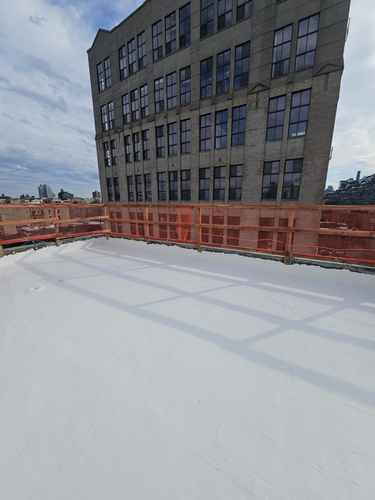
The membrane in the middle of a Brooklyn flat roof almost never fails first. Failures start at penetrations, at the roof to parapet transition, and at drains. Water that stands for more than forty eight hours after rain is the warning sign, because ponding both ages the membrane and signals that the drainage was never right. Clearing drains twice a year does more for the life of a flat roof than any product choice.
Attached construction means party wall flashing details that a detached house never has, and those are a common early failure. Row house flat roofs with parapets on three sides have far more linear feet of roof to wall transition than a suburban roof of the same area. And city trees drop enough debris to block drains and gutters repeatedly, which is why a roof here needs looking at more often than the same roof would in Nassau.
Clear the gutters and drains twice a year. Check the attic once a year with a flashlight for staining, damp insulation and daylight. Have the flashing looked at after any storm that moved roof material. Those three habits extend a Brooklyn roof more than any upgrade you can buy, because the things that end roofs early here are almost all maintenance failures rather than material failures.
Architectural asphalt shingles give 22 to 30 years, 3 tab gives 15 to 20, modified bitumen 15 to 20, EPDM 20 to 30, TPO 20 to 25, standing seam metal 40 to 70, and slate 75 to 100 plus. Those numbers assume adequate attic ventilation and that drains and gutters stay clear, which is where most Brooklyn roofs actually lose years.
Usually attic ventilation. Without intake at the eaves and exhaust at the ridge, summer heat is trapped against the underside of the deck and cooks the asphalt from below. The shingles age from the inside while looking fine from the street. It is also a condition of most manufacturer warranties, so a roof without it may not be covered at all.
At penetrations, at the roof to parapet transition and at drains, almost never in the middle of the membrane. Water standing more than forty eight hours after rain is the warning sign, because ponding ages the membrane and tells you the drainage was never correct. Clearing drains twice a year does more for a flat roof than any upgrade.
Yes. Attached construction adds party wall flashing details a detached house never has, and row house flat roofs with parapets on three sides have far more linear feet of roof to wall transition than a suburban roof of the same area. More transitions means more places to fail, which is why Brooklyn roofs need checking more often.
We give a realistic range rather than a single number, based on condition plus age rather than age alone. A twenty year old roof with sound flashing and good ventilation can have years left, while a fifteen year old roof with three failed penetrations is finished. Our free inspection photographs the condition and puts it in writing.
MLM Construction Group serves all Brooklyn neighborhoods. Licensed, insured & Google Guaranteed.
📞 (516) 713-9199 Get Free Estimate