📝 Roofing Guide
Flat Roof Guide for Brooklyn Homeowners: Materials, Lifespan, and What It Costs in 2026
By MLM Construction Group · Brooklyn, NY
If you own a flat roofed home or building in Brooklyn, at some point you'll face the TPO vs EPDM decision. Both are excellent single-ply membrane systems, but they suit different situations. Here's everything you need to know before calling a contractor.
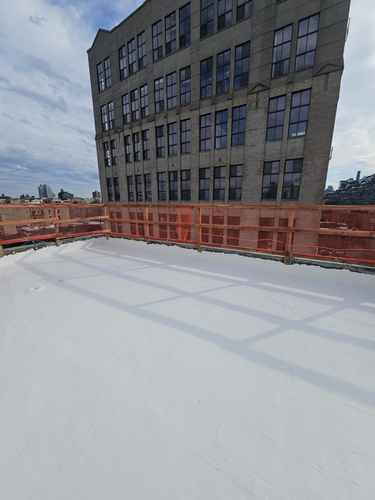
TPO (Thermoplastic Polyolefin) is a white reflective single-ply membrane, heat welded at the seams. It excels in energy efficiency, the white surface reflects sunlight and can reduce cooling costs by up to 15% in Brooklyn summers. Lifespan: 20 to 30 years. Cost: $8 to $14/sq ft installed.
EPDM (Ethylene Propylene Diene Monomer) is a black rubber membrane, the industry workhorse for decades. It's extremely durable, handles Brooklyn's freeze-thaw cycles exceptionally well, and is proven over 50+ years of use. Lifespan: 20 to 25 years. Cost: $7 to $11/sq ft installed.
For most Brooklyn homeowners with standard flat roofs: EPDM is the better value. Lower cost, proven durability, easier repairs. For commercial buildings or properties with rooftop units where energy savings matter: TPO pays off faster. Still unsure? Call MLM Construction Group for a free assessment, we'll inspect your roof and recommend the right system for your budget and building.
Yes. When your current roof reaches end of life, you can choose either system regardless of what's there now. The old membrane is removed and the new one is installed fresh.
Both perform well in Brooklyn. EPDM's flexibility gives it a slight edge in extreme cold, while TPO's reflectivity helps in hot summers. MLM installs both and can advise based on your specific roof.
Most Brooklyn flat roofs (1,000 to 2,500 sq ft) are completed in 1 to 2 days for either system.
| Factor | TPO | EPDM |
|---|---|---|
| Color and reflectivity | White, reflects over 80 percent of solar heat | Black, absorbs it. White EPDM exists but costs more |
| Seams | Heat welded, the strongest seam of the two | Adhesive or tape. Good, but adhesive ages |
| Cold weather installation | Welds fine in cold, the seam is hot air | Adhesives have minimum temperatures, generally 40 degrees |
| Puncture resistance | Good | Better. More forgiving of foot traffic and debris |
| Installed cost | $10 to $18 per sq ft | $9 to $16 per sq ft |
| Service life | 20 to 25 years | 20 to 30 years |
| Common failure | Seam weld done badly by an uncertified crew | Shrinkage pulling at the perimeter over time |
Choose TPO when the top floor gets hot and tenants complain about it. A black Brooklyn flat roof reaches around 160 degrees on a July afternoon, and a white reflective surface makes a difference people actually notice downstairs. Choose it also when the roof has many penetrations, because heat welded seams around curbs and pipes are stronger than adhered ones, and when the work has to happen in cold weather, since the weld does not care about temperature the way an adhesive does.
Choose EPDM when the roof is large and simple with few penetrations, when people will walk on it regularly, and when you want the longest service life from a single ply membrane. It is more forgiving of the debris and foot traffic a city roof actually gets.
Both systems are good. Both fail for the same reason: installation. A TPO roof is only as good as its welds, and a weld run at the wrong temperature or speed looks fine on day one and opens in year three. An EPDM roof is only as good as its perimeter detailing and its seam adhesive. Neither manufacturer warranty is valid unless a certified contractor installed it, which is the single most overlooked line in a roofing quote.
Row house roofs usually have parapets on three sides, so the roof to wall transition matters more than the field membrane. Both systems handle it well when flashed properly and both leak when it is not. Rooftop decks, AC units and bulkheads add penetrations, which tilts toward TPO. And if the install is happening in November or later, TPO is the practical answer because EPDM adhesives want above 40 degrees.
TPO if top floor heat is an issue, if the roof has many penetrations, or if the work is happening in cold weather, because heat welded seams do not depend on temperature the way adhesives do. EPDM if the roof is large and simple with few penetrations, gets regular foot traffic, and you want the longest service life from a single ply membrane.
EPDM slightly, at 20 to 30 years against TPO's 20 to 25. In practice the installer matters more than that gap. TPO fails at welds run at the wrong temperature or speed, EPDM fails at the perimeter as the membrane shrinks over time. Both numbers assume drains stay clear and the roof is inspected twice a year.
On the top floor, measurably. A black Brooklyn flat roof reaches around 160 degrees on a July afternoon while a white TPO surface reflects over 80 percent of that. Top floor apartments and commercial top floors are where occupants notice. It also slows the heat cycling that ages the membrane, so it helps the roof as well as the bill.
TPO runs $10 to $18 per square foot installed and EPDM $9 to $16, both including tear off and new insulation. On most Brooklyn row house roofs the difference between the two systems is smaller than the difference between a certified installer and an uncertified one, which also decides whether your manufacturer warranty is valid at all.
TPO yes, because the seam is made with a hot air welder and does not depend on ambient temperature. Adhered EPDM is the problem, since its adhesives generally need above 40 degrees to bond. In cold weather we change the system or the attachment method rather than installing something that will not bond properly and calling it finished.
MLM Construction Group serves all Brooklyn neighborhoods. Licensed, insured & Google Guaranteed.
📞 (516) 713-9199 Get Free Estimate