A ceiling stain that appears the week you turn the heat on, with no rain for days, is usually condensation inside the flue and not a roof leak. MLM Construction Group checks four things at a Brooklyn chimney: the cap, the counter flashing, the cricket and the mortar joints. Free inspection at (516) 713-9199.
The Stain Arrives With the Heat, Not With the Rain
Here is the call we get every year in the second half of October. There is a brown stain on the ceiling, or on the wall of the top floor bedroom, right where the chimney passes through. The homeowner is certain the roof is leaking.
Then they mention, almost as an aside, that it has not rained in a week. And that they turned the heat on for the first time last Tuesday.
That one detail changes the whole diagnosis. A roof leak follows rain. A chimney that stains when you start running the heat, on a dry cold night, is usually telling you something different and it is worth knowing which before anybody opens up a ceiling.
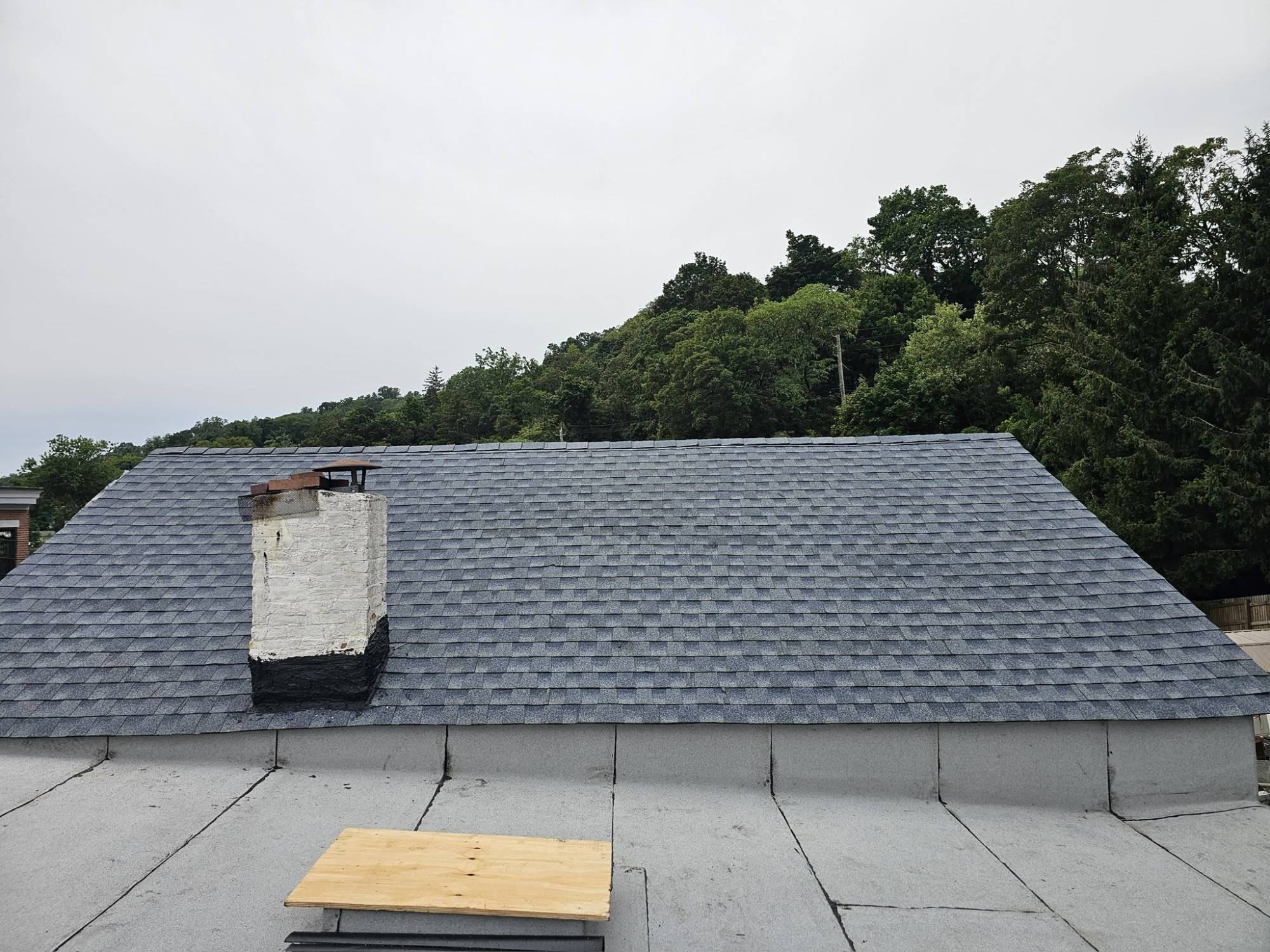
What Actually Happens Inside a Cold Chimney
Burning natural gas produces water. A lot of it. Every cubic foot of gas you burn turns into roughly a pint of water vapour going up the flue along with the carbon dioxide.
As long as the flue stays hot, that vapour stays a gas and leaves the building. The moment the inside surface of the flue drops below about 130 degrees, the vapour condenses on it. Now you have liquid water running down the inside of your chimney, and it is not clean water. It is mildly acidic.
On the first cold night of the season the masonry is at outdoor temperature, the chimney is stone cold all the way up, and the first hour or two of heating produces condensation top to bottom before anything warms up. That water soaks into the brick and the mortar. Where it reaches the inside face, you get the stain.
Why a New Boiler Often Makes This Worse
This is the part that surprises people. A homeowner replaces a sixty year old boiler with an efficient new one, and the following winter the chimney starts staining for the first time in decades.
The old boiler was inefficient, which meant it sent a large volume of very hot gas up the flue. That heat kept the whole chimney above the condensing point. The new one sends a smaller volume of much cooler exhaust up the exact same oversized masonry flue. It never gets warm. It condenses all season, every time it fires, not just on the first cold night.
The fix is not on the roof. It is a correctly sized liner, usually stainless, run the full height of the flue so the exhaust stays hot and the masonry never sees the moisture. If you have recently replaced a heating appliance and the chimney started staining afterwards, this is the first thing to check.
How to Tell Condensation From an Actual Leak
You can usually settle this yourself before anyone comes out, just by paying attention to the timing for a week or two.
It is condensation if the stain appears or darkens on cold dry nights, tracks with how hard the heating is running, is worst in the first weeks of the season and again during cold snaps, and shows no reaction at all to rain. It often comes with white powdery deposits on the brick outside, which is efflorescence, salts carried out of the masonry by moisture moving through it.
It is a roof or flashing leak if the stain appears or spreads during and just after rain, especially wind driven rain from one particular direction, and does nothing on a cold dry night no matter how hard the heat runs.
It is both, more often than you would expect. A chimney with a bad cap and failed flashing also has an unlined flue. In that case fixing only the roof gets you a partial result and an unhappy winter.
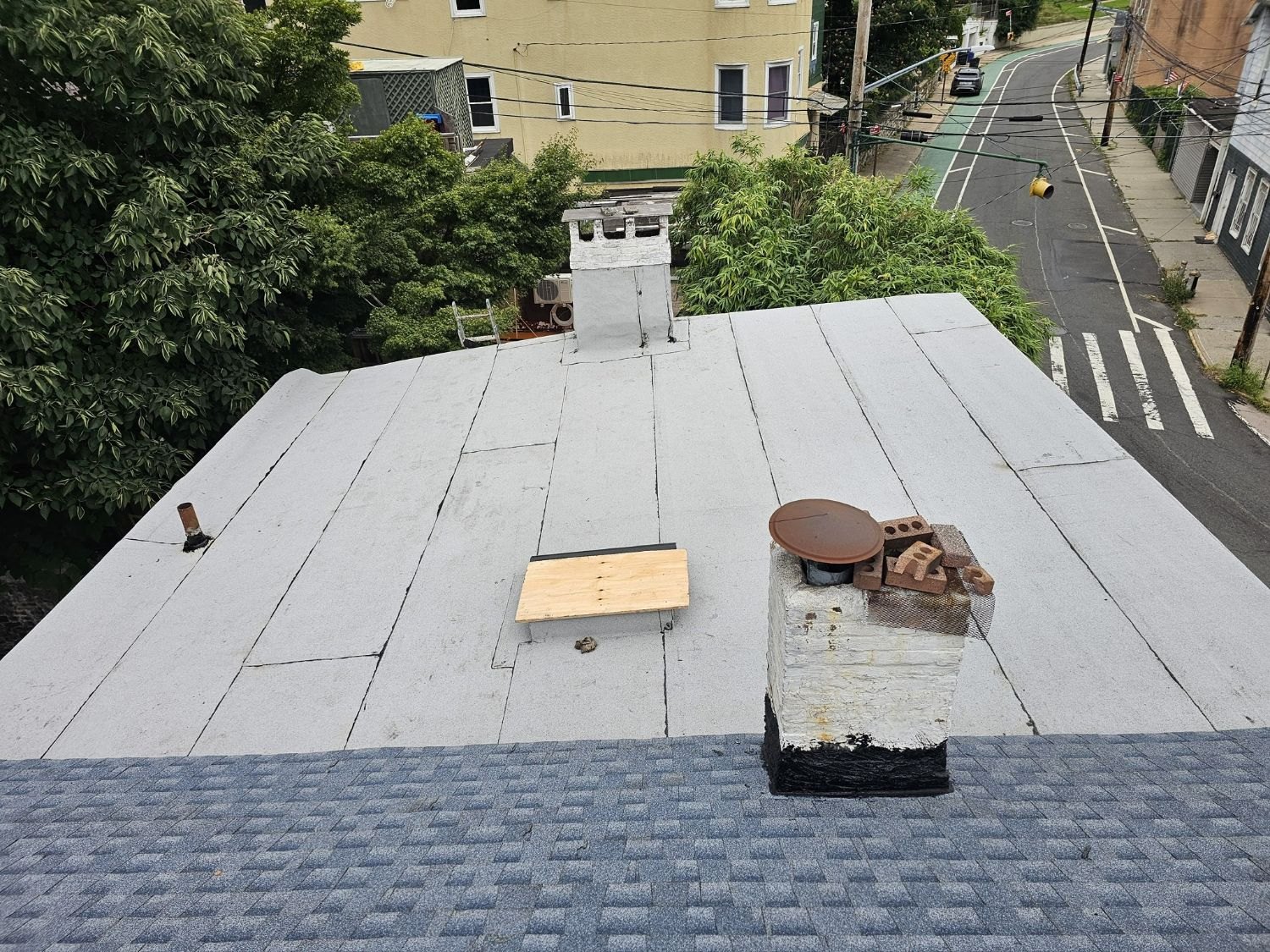
The Four Roof Side Failures We Find at Brooklyn Chimneys
When it is genuinely coming in from outside, it is almost always one of these four.
No cap, or a rusted out cap. An abandoned flue is still an open pipe down through your house. We find uncapped flues on Brooklyn row houses constantly, usually from a fireplace or an old appliance nobody has used since the eighties. Rain goes straight down it. This is the cheapest and most satisfying fix on the list.
Counter flashing that was caulked instead of cut in. Proper counter flashing is cut into the mortar joint and bent down over the step flashing. A lot of what we find is a strip of metal stuck to the face of the brick with sealant. Sealant on a vertical masonry face in Brooklyn weather gets about five years at best, then it lets go and the water goes behind the flashing.
No cricket on the high side. Any chimney wider than about thirty inches needs a cricket, a small peaked saddle behind it that splits the water and sends it around both sides. Without one, the uphill face of the chimney collects every leaf and every gallon of water coming down that slope and holds it against the masonry.
Open mortar joints in the chimney itself. Above the roof line the chimney gets weather on all four sides with no building behind it to keep it warm. It is the most exposed masonry on the house and it is usually the most neglected. Open joints take water in directly, and then freeze and thaw opens them further.
The Height Rule Nobody Checks
While anybody is up there, this is worth confirming. A chimney has to extend at least three feet above the point where it passes through the roof, and at least two feet above anything within ten feet of it horizontally. It is usually called the three two ten rule.
It matters for draft. A chimney that is too short, or that has been outgrown by a neighbour's extension or a rooftop bulkhead, does not draw properly. Poor draft means cooler flue gas, which means more condensation, which brings you straight back to the staining problem. We see this on Brooklyn blocks where somebody put a rear addition up and the chimney next door quietly stopped working right.
What to Do About It Now
If you are seeing a stain this month, do not open the ceiling yet. Note the date, note whether the heat was running, and note whether it rained. Two weeks of that tells you more than a camera in the wall.
Meanwhile the chimney itself deserves a look from the roof before the weather closes in. Cap, flashing, cricket, mortar joints. Those are all straightforward to address in October and genuinely unpleasant to address in January, when the masonry is frozen, mortar will not cure and nobody should be standing on an icy slope next to a chimney.
If it turns out the flue needs lining, that is a heating contractor's work rather than ours, and we will tell you so plainly. We would rather send you to the right trade than sell you a flashing job that does not fix your stain. Related reading: chimney repair in Brooklyn, how flashing leaks start, and attic condensation that looks exactly like a roof leak.
Frequently Asked Questions
Why does my ceiling stain near the chimney when it has not rained?
Because it is probably condensation inside the flue rather than a leak. Burning gas produces water vapour, and when the inside of the chimney is below roughly 130 degrees that vapour turns to liquid on the masonry. On the first cold nights of the season the chimney is stone cold top to bottom, so it condenses heavily. The stain tracks the heating, not the weather.
Can a new high efficiency boiler cause chimney staining?
Yes, and it is one of the most common causes we see. A new appliance sends less exhaust at a much lower temperature up the same oversized masonry flue the old one used. The flue never gets hot enough to stay dry, so it condenses every time the system fires. The fix is a correctly sized liner, not roof work.
How do I tell a chimney leak from condensation?
Watch the timing for two weeks. If the stain appears or darkens on cold dry nights and tracks how hard the heat is running, it is condensation. If it appears during and just after rain, especially wind driven rain from one direction, and ignores cold dry nights, it is a roof or flashing leak. Sometimes it is genuinely both.
What is a chimney cricket and do I need one?
A cricket is a small peaked saddle built on the uphill side of a chimney that splits water and debris and sends it around both sides. Any chimney wider than about thirty inches across the slope should have one. Without it the high side of the chimney collects every leaf and every gallon coming down that roof and holds it against the masonry.
How high does a chimney have to be above the roof?
At least three feet above where it passes through the roof, and at least two feet above anything within ten feet of it horizontally. It is known as the three two ten rule. A chimney that is too short draws poorly, the flue gas runs cooler, and cooler flue gas means more condensation inside the masonry.
Is October too late to repair chimney flashing in Brooklyn?
No, October is a good month for it. Mortar and sealant still cure reliably and the roof is dry and safe to work on. January is the problem. Frozen masonry will not take fresh mortar, sealants do not bond in the cold, and nobody should be working next to a chimney on an icy slope. Chimney work is the thing to schedule now rather than defer.
Free Brooklyn Chimney and Flashing Inspection
We go up, photograph the cap, the flashing, the cricket and every mortar joint above the roof line, and tell you plainly whether what you are seeing is a leak or condensation. If it is a flue problem we say so and point you to the right trade. Brooklyn, Queens, Manhattan, the Bronx, Staten Island and Nassau County.
📞 (516) 713-9199 Get Free Estimate