Almost every Brooklyn row house has a bulkhead door or a hatch onto the roof, and the flashing around it is the detail most often skipped. The curb should stand at least 8 inches above the finished roof. MLM Construction Group hose tests bulkheads free before the freeze. (516) 713-9199.
The One Opening in an Otherwise Sealed Roof
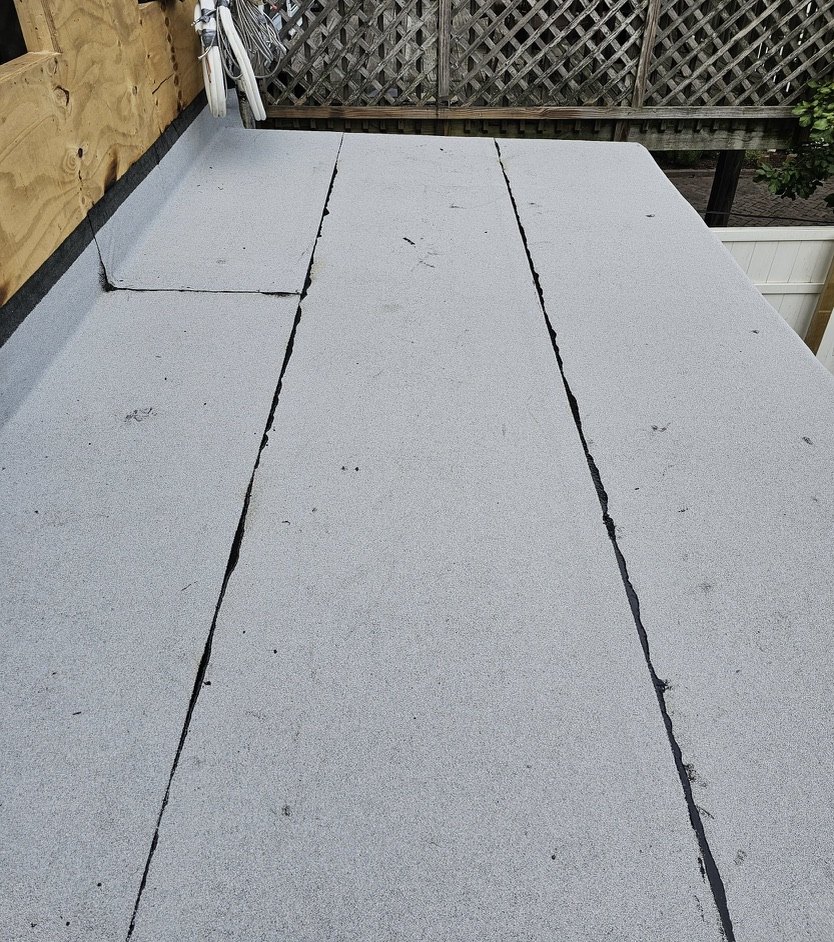
A flat roof is a sealed surface. Membrane, laps, parapet base, drain. Then somebody cut a hole in it so people could get up there, and framed a box around the hole, and hung a door or a hatch on the box.
That box is the bulkhead. On a typical Brooklyn row house it is the little structure at the top of the stairs with a door that opens onto the roof. On smaller buildings it is a hinged steel hatch you push up from a ladder. Either way it is the only deliberate penetration in the roof big enough to walk through, and it is almost never the thing people suspect when a ceiling stains.
We get called for roof leaks all year. A meaningful share of them are not the roof. They are the bulkhead.
What the Detail Is Supposed to Look Like
A bulkhead or hatch is flashed the same way as any curb on a flat roof, and the rules are not vague.
- The curb stands at least 8 inches above the finished roof surface
- The roof membrane turns up and runs the full height of the curb, not a few inches
- The top of that upturn is mechanically terminated with a bar or a cleat, not just stuck down
- A counterflashing or a metal cap covers the termination so water cannot get behind it
- Sealant goes in as the last line of defense, behind the metal, never as the metal
Stand on your roof and look at your bulkhead. If the membrane runs up two or three inches and stops, if there is no metal cap over the top of it, or if the only thing between the roof and the door frame is a bead of grey caulk somebody ran four years ago, you have found your leak.
Why It Leaks in Winter and Not in Summer
This is the part that confuses people, because the bulkhead is dry through an entire summer of thunderstorms and then stains a ceiling in January.
Ordinary summer rain falls more or less straight down. A low curb sheds it. The water hits the roof, runs to the drain, and never gets near the top of the flashing.
Winter changes the direction. A nor'easter drives rain horizontally at the door for six hours straight. And snow does something worse: it drifts against the curb, sits there for days, and melts slowly from the bottom where the building is warm. That meltwater is not falling, it is standing against the side of the curb at a level no rainstorm ever reaches. If the flashing stops at three inches and the drift is eight inches deep, the water simply walks over the top.
There is a related version of this on shingle roofs, where ice dams back meltwater up under the shingles. Same physics, different detail.
Why the Stain Is Never Where the Leak Is
Water that gets past a bulkhead curb does not drop straight down into the room below. It lands on the top of the roof deck, inside the assembly, and then it travels.
It runs along the top of a joist until it finds a hole, or down the inside face of the bulkhead wall, or along a pipe. By the time it appears on a ceiling it can easily be ten or fifteen feet from where it entered. We have traced stains at the front of a building to a hatch at the back.
This is how people end up paying for a roof they did not need. The stain is on the top floor ceiling, so the roof gets replaced, and six weeks later the stain is back because nobody touched the curb. It is also why we hose test before anyone prices anything. Twenty minutes with a hose at the bulkhead, with someone watching inside, rules it in or out for nothing.
The Five Minute Check You Can Do Yourself
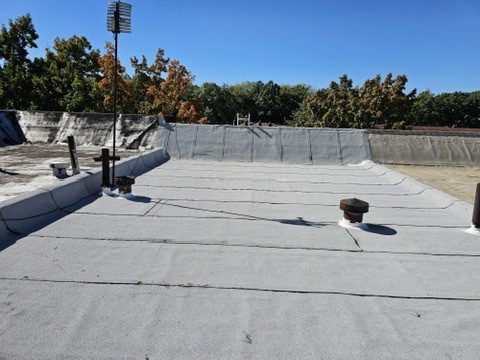
Go up on a dry day. You are looking at five things and none of them need a tool other than a tape measure.
Measure the curb. Roof surface to the top of the flashing. Under 8 inches is the finding.
Look for metal. There should be a counterflashing or a cap over the top of the membrane upturn. If you can see the cut edge of the roofing material, there is nothing protecting it.
Press the corners. The corners of a curb are where the flashing has to be cut and folded, and they are where it splits. Soft, lifted or open corners are the most common failure we find.
Check the door itself. A bulkhead door needs a threshold, a drip over the head and weatherstripping that still has spring in it. A door that rattles in the frame is letting wind driven rain through the gap, which has nothing to do with the roof at all.
Look at the wood. Push a key or a screwdriver into the bottom corner of the curb framing. If it goes in, the curb is rotten and has been wet for a while, and a new bead of sealant is not going to fix a rotten curb.
Condensation Pretending To Be a Leak
One honest correction before anyone calls a roofer. Not every drip under a hatch is a leak.
A bare steel hatch over a heated stairwell is a cold surface with warm moist air underneath it. On a cold morning that underside goes below the dew point and collects condensation exactly like a window, and then it drips. People describe it as a leak and it is not.
The way to tell them apart is the weather. If the drip happens on cold clear mornings with no rain, it is condensation, and the answer is insulation on the hatch and better weatherstripping. If it happens during or after driving rain or a thaw, it is the flashing. We wrote about the same confusion on a larger scale in attic condensation that looks like a roof leak.
What the Repair Involves
It depends entirely on what the curb is made of and what shape it is in.
If the membrane is sound and the problem is a failed sealant joint or a missing counterflashing, it is a half day. New termination bar, new metal, properly lapped, sealed behind the metal rather than in front of it.
If the curb is too short, it gets built up so the flashing can reach 8 inches and the membrane is reterminated at the new height. That is usually a day.
If the framing is rotten, that section comes out and gets rebuilt before anything goes back over it. Sealing a rotten curb is covering the evidence, and it will be back on your ceiling by March.
Either way it is small money compared to a roof, which is the whole reason it is worth checking before the first freeze rather than after the first stain.
Frequently Asked Questions
Where is the bulkhead on a Brooklyn row house?
It is the small structure at the top of the stairs that opens onto the roof, sometimes a full doorway with a short hallway and sometimes just a hinged hatch in the roof deck. Almost every Brooklyn row house and small apartment building has one, because it is how anyone gets to the roof at all.
How high should a roof hatch curb be?
The roofing manufacturers and NRCA detailing both call for the curb to stand at least 8 inches above the finished roof surface, with the membrane turned up the full height of the curb and terminated under a counterflashing or a cap. Anything lower than that and wind driven rain or snow meltwater gets over the top of the flashing.
Why does water come in around my roof hatch only sometimes?
Because it needs the wind. A low or poorly flashed curb sheds ordinary vertical rain fine. It fails when rain is driven sideways at the door, or when snow drifts against the curb and melts slowly from the bottom. That is why the stain appears after a nor'easter and then stays dry for three months.
Can a bulkhead leak look like a roof leak?
Constantly. Water comes in at the curb, runs along the top of the deck or down the inside of the bulkhead wall, and shows up as a stain on a ceiling ten or fifteen feet away. People replace a roof and still have the stain. Before anyone prices a roof we hose test the bulkhead, because it is cheap to rule out.
What does it cost to fix a leaking bulkhead or roof hatch?
If the membrane is sound and the problem is failed sealant or a missing counterflashing, it is a half day with new flashing and termination. If the curb itself is rotten or too short, the curb gets rebuilt and the membrane reterminated, which is usually one day. We quote it in writing after we look, and looking is free.
Should I seal around the hatch with caulk myself?
Caulk buys you a season at most. Sealant is meant to be the last line of defense behind a flashing, not the flashing itself. If the only thing holding water out of your bulkhead is a bead of caulk, that is the finding, not the fix. It is still worth doing in November if the alternative is leaving it open all winter.
Does a roof hatch need to be insulated?
It helps more than people expect. An uninsulated steel hatch in a heated stairwell runs cold, collects condensation on the underside and drips. Homeowners call that a leak. If the drip only happens on cold mornings and never during rain, the problem is condensation and the fix is insulation and weatherstripping, not roofing.
Free Bulkhead and Flat Roof Check Before the Freeze
We measure the curb, pull the counterflashing where we need to, hose test the detail with someone watching inside, and photograph what we find. You get a straight answer on whether this is a half day of flashing or something bigger, in writing. Brooklyn, Queens, Manhattan, the Bronx, Staten Island and Nassau County.
📞 (516) 713-9199 Get Free Estimate