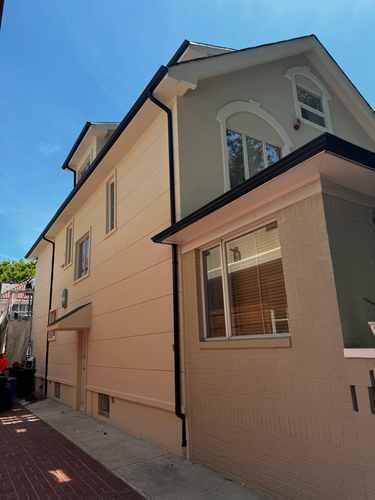
One Borough, Three Very Different Roofs
The western half of Queens, through Astoria, Long Island City, Sunnyside and Ridgewood, is mostly attached and semi detached brick from the 1910s to the 1930s. Flat or low slope main roofs, parapet walls on three sides, and far more linear feet of roof to wall transition than the square footage suggests. Almost every leak we trace in that half of the borough starts at a parapet, a party wall, or the joint where a rear extension was added decades after the house was built.
East and north, through Bayside, Whitestone, Douglaston, Little Neck and Jamaica Estates, the stock turns detached with real driveways and yards. Pitched shingle roofs, complex rooflines on the Tudors, and genuine attic space above. The failures there are different: flashing at dormers and chimneys, attic ventilation that was never adequate, and ice damming at eaves that sit over unconditioned overhangs.
Then there is the co op and condo layer across Forest Hills, Rego Park, Kew Gardens and Jackson Heights. That is building scale work: large flat roofs with mechanical equipment, bulkheads, setbacks and drains, a managing agent, a certificate of insurance naming the right entities, and work hours the building controls. The membrane almost never fails first. Curbs, penetrations and drains do.
The practical consequence is that a roofer who only works one of those three types will mis-price the other two. We carry crews and material for all three because in Queens you cannot pick.
What Breaks in Queens Specifically
Parapet coping on attached blocks
Cracked coping lets water straight into the masonry. It runs down inside the wall and appears on a ceiling two floors below, nowhere near the roof.
Rear extension junctions
Nearly every attached Queens house gained a back addition. The joint where it meets the original roof is rarely flashed to a standard that survives thirty winters.
Attic ventilation on the detached stock
Soffit vents blocked by insulation, no ridge exhaust, and a deck that cooks in summer and ice dams in winter.
Drains and curbs on co op roofs
Blocked or undersized drains cause ponding, and ponding both ages the membrane and signals the slope was never right.
Airport corridor wind
Blocks under the approach paths take sustained wind that finds any shingle course that never sealed properly.
Queens Neighborhoods We Work In Regularly
Astoria, Bayside, Flushing, Forest Hills, Jackson Heights, Jamaica
Frequently Asked: Queens Roofing
How much does roof work cost in Queens?
A flat roof replacement runs $12 to $22 per square foot including tear off and new insulation. Shingle replacement on a detached Queens house typically lands between $9,000 and $26,000. Attached row houses with parapets on three sides cost more per square foot than the area suggests, because the transitions are where the labour is. Deck replacement is $95 to $180 per sheet and only charged where the sheathing is actually rotted.
Why does my ceiling leak when the roof was recently done?
On an attached Queens house it is usually the parapet rather than the roof field. Cracked coping on the parapet wall lets water into the masonry, where it travels down inside and surfaces on a ceiling two floors below. A roof replacement that did not address the coping will not stop it, and this is the single most common repeat call we take in western Queens.
Do you work on co ops and condo buildings?
Yes, and a large share of our Queens work is exactly that. We issue a certificate of insurance naming the building entity and the managing agent before anyone arrives, work the hours the building allows, and book service elevator and roof access in advance rather than on the morning of day one.
Do I need a permit for a roof in Queens?
Replacing a roof covering in kind on a one or two family house generally does not require a DOB permit. Structural work, changes to the roof assembly, and larger buildings do. Landmarked blocks carry additional review. We check your address and pull the permit when one is required rather than handing that back to you.
How fast can you get to Queens for an emergency?
We aim to respond within the hour for active leaks anywhere in Queens, and we answer the phone 24 hours a day at (516) 713-9199. We triage on the call first so the crew arrives with the right material instead of making a second trip.