Howard Beach sits on the water, and every roofing decision here follows from that. The neighbourhood runs along Jamaica Bay between Cross Bay Boulevard and the canals, and the sections closest to the water, Hamilton Beach, Old Howard Beach and the streets off Hawtree Basin and Shellbank Basin, take wind and salt air that the rest of Queens never sees.
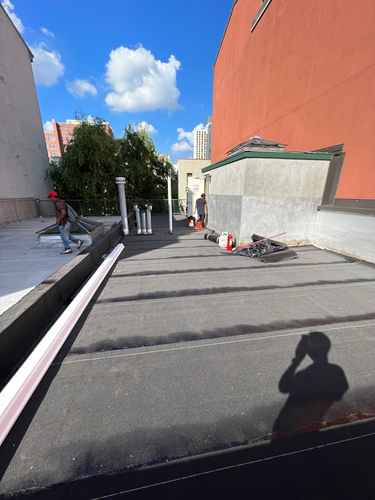
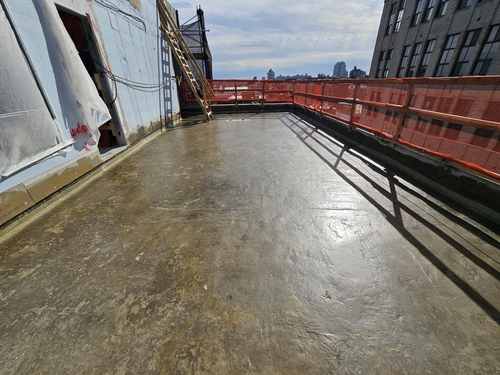
Most of the housing is detached and semi detached one and two family, built from the 1920s through the 1960s, with hip or gable asphalt shingle roofs. Rockwood Park and Lindenwood add later brick and co-op stock. A great many of these houses also carry a flat roofed rear extension or an attached garage, so a single Howard Beach roof is often two roofs with a transition between them, and that transition is where most of the leaks we are called for actually start.
Then there is Sandy. In October 2012 the surge off Jamaica Bay went through this neighbourhood hard. A large number of houses were repaired, raised or rebuilt in the two or three years afterwards, which means an unusual concentration of roofs that all went on at roughly the same time. Those roofs are now twelve and thirteen years old. On a standard architectural shingle that is the point where the granule loss starts showing and the sealant strips begin letting go at the edges. We are seeing exactly that across the neighbourhood right now.
Salt air is the other Howard Beach specific. Within a few blocks of the bay it attacks the metal first and the shingles second. Galvanized flashing that would last decades inland corrodes at the fasteners, gutter spikes rust out of the fascia, and drip edge goes before the field of the roof does. When we work near the water we specify aluminium or stainless where it matters and we check every metal component rather than only the ones that are obviously failing. Replacing shingles and leaving corroded flashing underneath is how a new roof leaks in its second year.
Wind is the third. An exposed bay facing roof with nothing upwind of it gets loads a mid block house in Forest Hills never experiences. That makes the nailing pattern, the starter course and the ridge detail genuinely important rather than a matter of preference, and it makes a six nail pattern worth the small extra cost. It also means we hand seal in cold weather without being asked, because an unsealed shingle in a bay wind is a shingle on your lawn.
We work the whole neighbourhood: Old Howard Beach, Rockwood Park, Lindenwood, Hamilton Beach and the blocks either side of Cross Bay Boulevard. Call (516) 713-9199 or (917) 570-7311 for a free estimate.
Q: My roof was replaced after Sandy. Is it due already?
A: Quite possibly. Most of the post Sandy work in Howard Beach went on between 2013 and 2015, which puts those roofs at twelve or thirteen years. A standard architectural shingle is rated longer than that, but rated life assumes an inland roof. On a bay facing house with salt air and wind loading, twelve years is realistically when you start inspecting annually rather than assuming you have another decade.
Q: Does salt air really damage a roof this far from the ocean?
A: Jamaica Bay is close enough. Salt in the air attacks metal long before it affects the shingles, so what we find near the water is corroded flashing, rusted gutter fasteners and drip edge failing while the field of the roof still looks acceptable. It is the main reason we specify aluminium or stainless components on waterfront streets and check every piece of metal on an inspection.
Q: Why do so many Howard Beach leaks start at the back extension?
A: Because that is where a pitched roof meets a flat one. The transition needs proper flashing carried up under the shingles and a membrane that turns up the wall behind it. A lot of what we open up is a tar patch over a joint that was never detailed correctly in the first place. Fix the transition and the leak stops. Patch the ceiling and it comes back every storm.
Q: Do I need extra wind protection on a bay facing roof?
A: It is worth doing. A six nail pattern instead of four, a properly fastened starter course at the eaves and rakes, and correct ridge cap attachment make a real difference on an exposed roof with open water upwind. None of it adds much to the cost of a full replacement and all of it is nearly impossible to add afterwards.
Q: Can you work on a house that was raised after the flood?
A: Yes, and we do regularly in Howard Beach and Hamilton Beach. A raised house is taller and often more exposed than it was before, which changes the access and the staging rather than the roofing itself. It is worth telling us at the estimate so we bring the right equipment on the first visit rather than the second.
Unlike competitors who specialize in only one trade, MLM Construction Group handles roofing, stucco, EIFS, and gutters. One contractor for your entire exterior.
Background checked by Google. You are protected on every job. Satisfaction guaranteed or Google refunds you.
The highest possible BBB rating. Verified track record of quality and customer satisfaction across Brooklyn.
Factory certified GAF installer held to proper installation standards, with a manufacturer backed materials warranty on every roof.
Certified installer #69597. Firestone commercial systems backed by manufacturer warranty.
Active leak in Howard Beach? We respond fast, nights, weekends and holidays. Call (516) 713-9199.
Every major installation backed by our 10-year workmanship warranty plus manufacturer materials warranty.
Call Meir Levy directly or fill out the form on our homepage. We respond within 24 hours.
📞 (516) 713-9199 📞 (917) 570-7311 📋 Free Estimate Form