📝 Roofing Guide
Flat Roof Guide for Brooklyn Homeowners: Materials, Lifespan, and What It Costs in 2026
By MLM Construction Group · Brooklyn, NY
Most Brooklyn homes have flat roofs, and most homeowners know surprisingly little about them until they start leaking. This guide covers everything you need to know about flat roof systems, materials, costs, and how to choose the right contractor for your Brooklyn property.
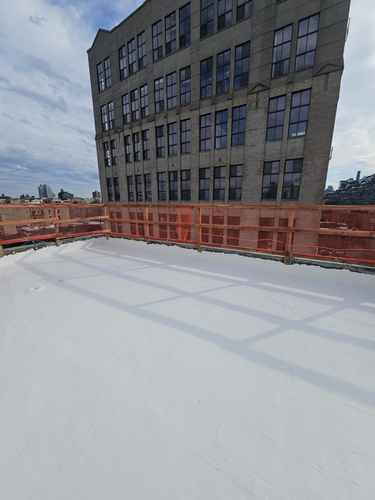
Not all flat roofs are created equal. Here are the systems MLM Construction Group installs most frequently in Brooklyn, and how they compare:
A properly installed flat roof in Brooklyn should last 15 to 25 years depending on the system. The number one cause of premature failure is poor installation, specifically improper drainage and flashing details. That is why choosing a licensed, experienced contractor matters more than price.
⚠️ If a contractor quotes you a flat roof at unusually low prices, they are often cutting corners on materials or layers. A $4,000 flat roof job that fails in 3 years is far more expensive than a $9,000 job that lasts 20 years.
For a typical Brooklyn rowhouse with a 1,000 to 1,500 sq ft flat roof:
Do not wait until you have an active leak inside your home. These are the warning signs that your flat roof is approaching end of life:
| System | Installed cost | Life | Best for |
|---|---|---|---|
| Modified bitumen (torch or self adhered) | $8 to $15 per sq ft | 15 to 20 years | Row house roofs with heavy foot traffic |
| EPDM rubber | $9 to $16 per sq ft | 20 to 30 years | Large simple roofs with few penetrations |
| TPO | $10 to $18 per sq ft | 20 to 25 years | Reflectivity matters, or cold weather installation |
| Liquid applied coating over sound roof | $3.50 to $7 per sq ft | 10 to 15 years | Extending a membrane that is still dry underneath |
Not in the field of the membrane. Almost every flat roof failure we are called to starts in one of four places: a penetration such as a vent, pipe boot or AC curb, the transition where the roof meets a parapet wall, a drain that is blocked or was undersized from the start, and the seams. A roof can have a perfectly sound membrane across ninety five percent of its area and still be letting water in at a six inch detail.
Water still standing forty eight hours after rain means one of two things. Either the drains are blocked, which is cheap and immediate to fix, or the roof has lost its slope because the deck settled or the insulation compressed, which is a much bigger job. The distinction matters enormously for cost, and it is settled by inspection rather than by guessing. Ponding also ages the membrane faster and adds real weight: a single inch of standing water across a thousand square feet is over five tons.
A row house flat roof typically has parapet walls on three sides, which means far more linear feet of roof to wall transition than a suburban roof of the same area. Cracked coping on top of that parapet lets water straight into the wall, where it runs down inside and appears on a ceiling two floors below, nowhere near the roof. Any serious flat roof assessment in Brooklyn looks at the parapet as part of the roof, not as masonry work for someone else.
If people will be walking on the roof, modified bitumen takes it best. If the roof is large and simple with few penetrations, EPDM is efficient and long lived. If top floor heat is a complaint, a white TPO or a reflective coating makes a measurable difference on a black roof that hits 160 degrees in July. If the existing membrane is still sound and dry underneath, a coating extends it for a fraction of a replacement, and we core test for trapped moisture before recommending that rather than sealing water in.
Modified bitumen runs $8 to $15 per square foot installed, EPDM $9 to $16, and TPO $10 to $18. Those include tear off and new insulation. A liquid applied coating over a membrane that is still sound and dry underneath runs $3.50 to $7 and extends the roof rather than replacing it.
Modified bitumen if the roof gets foot traffic, because it takes it best. EPDM if the roof is large and simple with few penetrations. TPO if top floor heat is a complaint, because a white reflective surface makes a measurable difference on a roof that reaches 160 degrees in July. The right answer depends on your roof, not on which system a contractor prefers to install.
Water still there forty eight hours after rain is. It means either blocked drains, which is cheap and immediate to fix, or lost slope from a settled deck or compressed insulation, which is a far bigger job. An inch of standing water across a thousand square feet is over five tons, and ponding ages the membrane faster. An inspection settles which one you have.
Because flat roofs rarely fail in the field. They fail at penetrations, at the roof to parapet transition, at drains and at seams. On a Brooklyn row house the parapet is the most common culprit: cracked coping lets water into the wall, it runs down inside and surfaces two floors below, nowhere near where it entered.
If the membrane is still sound and the insulation underneath is dry, yes, and it costs a fraction of a replacement. If there is trapped moisture below, a coating seals the water in and you pay twice. We core test or scan for moisture before recommending one, and we will tell you when it is the wrong call.
Call Meir Levy directly. BBB A+, Google Guaranteed, GAF Certified. Serving all of Brooklyn since 2009.
📞 (516) 713-9199 📋 Free EstimateProtect your flat roof year round. Join our Roof Care Plan (free first inspection, from $499/yr).