🏠 Roofing Guide · 2026
Roof Replacement Process in Brooklyn: Step by Step
By MLM Construction Group · Brooklyn, NY
A roof replacement is one of the biggest investments you'll make in your Brooklyn home, and one of the most misunderstood. Homeowners often picture a chaotic week of noise and mystery. In reality, a well run reroof follows a clear, predictable sequence. Here's exactly what happens, in order, so you know what to expect on your street, at your curb, and over your head.
Every replacement starts with a real inspection, not a guess from the sidewalk. A contractor checks the shingles or membrane, the flashing, the decking condition where visible, the attic for moisture and ventilation, and the gutters. From that, you get a written scope and price. If you're not sure you even need a full replacement yet, our guide on the signs you need a new roof helps you tell repair from replacement, and the cost of a new roof in Brooklyn breaks down what drives the price.
Once you approve the estimate, you choose your system: architectural asphalt shingles, a flat roof membrane like TPO or EPDM, metal, and the color. The contractor orders materials, confirms the warranty (get the manufacturer and workmanship warranty in writing), and handles any required permit or DOB filing. A reputable Brooklyn roofer schedules around the weather and lets you know the start date and expected duration.
On the morning of the job, the crew protects your property before touching the roof: tarps over landscaping and siding, plywood over delicate areas, and a dumpster or dump trailer positioned at the curb for debris. This prep is a quiet sign of a professional crew, it's what keeps torn off shingles and nails out of your garden and gutters.
The old roof comes off down to the decking. This is the loudest, dustiest phase, and it's also where hidden problems surface, soft or rotted plywood, old leaks, or improper prior work. A good crew tears off only as much as they can re cover the same day, so your home is never left open to a surprise storm.
⚠️ Watch how much they tear off at once. Inexperienced or rushed crews strip the entire roof in one shot and gamble on the forecast. The right approach is section by section tear-off and same day dry-in, so a sudden Brooklyn afternoon shower can't flood your ceilings.
With the roof stripped, the crew inspects the wood decking. Any rotted, delaminated, or water damaged sheathing is replaced. This is the foundation everything else sits on, so it's not a place to cut corners. Decking repairs are sometimes an added cost that couldn't be seen before tear-off; an honest contractor shows you the damage and prices it transparently.
Next comes the layer most homeowners never see but that quietly protects the house. An ice-and-water shield goes down at the eaves, valleys, and penetrations, the spots most prone to leaks and, in a Brooklyn winter, to ice dams. Synthetic underlayment covers the rest of the deck as a secondary barrier beneath the shingles.
New metal flashing is installed at chimneys, walls, valleys, vents, and skylights, along with drip edge at the perimeter. Flashing is where the majority of roof leaks actually begin. See why flashing leaks, so reusing old, bent flashing to save time is a false economy. A quality reroof always includes fresh flashing.
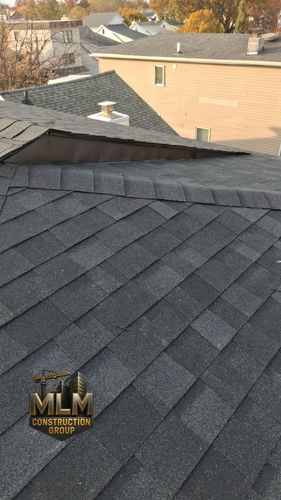
Now the visible roof goes on: courses of shingles from the eaves up, or a fully adhered/mechanically fastened membrane on a flat roof, finished with ridge caps or edge terminations. Proper attic ventilation, ridge and soffit vents: is installed or upgraded here, because ventilation is what makes a new roof last its full lifespan instead of cooking from the inside.
A professional crew leaves your property cleaner than a lot of homeowners expect. They sweep and run a magnetic roller over the lawn, driveway, and street to catch every stray nail, haul away all debris, and do a final walkthrough with you, showing the finished work, handing over the warranty paperwork, and confirming the workmanship is signed off. That paperwork matters at resale, so keep it.
You can make the job faster and safer: move cars out of the driveway, take fragile items off interior walls (the vibration travels), cover attic belongings, keep kids and pets indoors, and give neighbors a heads up about the noise. Most important, hire a licensed, insured, local contractor. Our guide on how to choose a Brooklyn roofing contractor covers the questions that separate a pro from a storm chaser.
Most residential replacements take one to three days, weather permitting. A small flat roof or simple shingle job can finish in a day; a larger, steeper, or multi layer roof with decking repairs runs longer. The crew normally completes tear-off and dry-in the first day so the roof is never open to the weather overnight.
A like for like residential reroof is often allowed under the Building Code without a full permit, but it depends on the scope and building type. A licensed contractor knows when a permit or DOB filing is required and pulls it for you, never skip a required permit to save time, as it can cause problems at resale.
A good crew tears off only what they can dry-in the same day and tarps or pauses if rain threatens, so your home is never left open to a storm. This is a major reason to hire an experienced local roofer rather than a crew that strips the whole roof at once.
Move cars out of the driveway, take fragile items off interior walls and shelves, cover or clear attic belongings, make a clear path for the crew and dumpster, keep kids and pets indoors, and let neighbors know about the noise. A tidy, accessible site helps the job move faster and safer.
MLM Construction Group handles the full roof replacement, inspection, permits, tear-off, and a clean, warrantied install. Licensed, insured & Google Guaranteed, serving Brooklyn since 2009.
📞 (516) 713-9199 Get Free Estimate